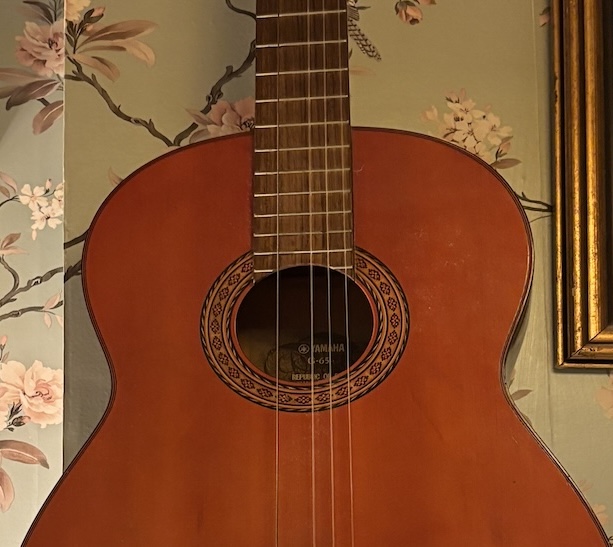
A few days ago while walking through the main lobby at Union station I saw an elderly man holding a guitar that, at first glance, appeared to be brand new. However, looking further at the grooves of the wood and the hanging lines of guitar string from the instrument’s head it was obviously something he’d held on to for quite a while, a valued possession. It got me thinking about Willie Nelson’s guitar, Trigger. The massive hole in the side, the worn out neck. A guitar that’s most entirely on life support versus a guitar that’s dieted well, hasn’t smoked, drinks only a minor amount - the ‘Sicilian Grandfather’ of guitars versus the ‘Hells Angel’, Trigger.

The act of polishing can be a change to an environment also. Daily maintenance of a space means an investment into that space. The act of a ‘deep clean’ in particular. At an old job of mine the back office was reorganized and fully cleaned by head office when the former manager quit the position. When that happened, there was a certain level of deep lizard brain satisfaction gained from the space’s transition from disorder to order. The organization and archiving, pieces formed into a whole.

For the definition of the difference between well-used and maintained vs well-kept and polished, I’d say that by the natural rules of life an item is worn away through extended, continuous use. Polishing and cleaning shows an affection, affinity towards that item, but so does an extreme amount of tarnish and wear. If someone cares enough about a guitar to keep it clean, polished and restrung, that obviously shows their affinity for the item. They want it to survive, and to continue life ‘as is’. Likewise with one covered in holes and dents. When you see an item like Nelson’s Trigger it represents survival at all costs - a sort of utilitarian rugged-ness that feels somewhat like you’re on a desert island in the middle of the South Pacific. Your only possession is your guitar, and maintaining it is your only compulsion. You’d probably end up with something that looked cool as hell, and impossibly unique. (coconut panelling/palm strings… et cetera et cetera)  An example of this philosophy comes from when Maurice Sendak sent a young fan an original drawing of his. The mother wrote back, saying “We’re so sorry, but he loved it so much that he ate it.”.

I was very much like this young fan as a child. You could tell which books were mine because they were not treated particularly well. Torn edges, crayon doodles on the interior covers or on the images in picture books that I most wanted to interact with and loved the most. Or rather, they were so much of a sole focus in my young career as a reader that I loved them so much that I ‘ate’ them. The consumability of an item being also an important aspect of this ‘tarnishing versus polishing’ essay. Think about this. Two of your aunts give you an edible present on Christmas. One aunt, Sharon - she knows you very well. She understands that you absolutely love fruitcake and have been waiting all year for Sharon’s fruitcake. The other aunt, Belinda, doesn’t know you in the slightest. She gives you a big bag of cookies, wrapped in plastic packaging. You love fruitcake, hate cookies.

Next Christmas comes around, Sharon and Belinda are BACK. When Belinda opens the cupboard to grab herself some hot chocolate, she finds her big bag of cookies stale and dusty on the shelf. A year old. In cookie preschool. Your fruitcake was eaten the night after it was gifted, a year before. Sharon 1 - Belinda 0.

Marshall Arisman, artist, illustrator and graphic designer whose work you may recognize as gracing the cover of ‘Silence of the Lambs’ describes a similar consumption=love philosophy in hisYoutube video titled ‘Precious Art’.

Adorned in a papier-mâché monkey mask, Arisman lifts an art book to the camera, telling us that the way to properly enjoy any new, precious art book after purchasing it for the first time is to pick it up, hold it in your hands, and TEAR a page out of the book. Now you’ve got it forever. You’re going to read that book cover to cover. You have to.

But then again, personally I’m in two camps on the matter. I may have been a devourer of books in my younger years (and at the very least up to my university days - at one point an eccentric professor of mine told us to experiment with eating pages from a book to glean their knowledge through chewing the author’s words) but I love polishing brass and keeping my belongings well-shorn. Recently mending clothes has been something I’m interested in. But - just as much as that, the human aspect of wear and tear is so satisfying to me. Place a sheet in a room and get people to muddy their feet and walk on it. Now that sheet is an object ‘of’ something. Of a certain time and place and era. One of the saddest parts of the Art Gallery of Ontario’s changes to their collection is the removal of painter David Milne’s painter’s box and winter coat from the titular Milne Centre, which I religiously came back to check on every time I went to the gallery. Just like this coat that Milne never imagined would rest in a downtown gallery after his death, You can use the example of a plastic pen purchased at a dollar store without thinking about the item as anything more than something to use one time. In that, the novelty of it comes from the time spent by the owner in keeping it on life support by grafting, cleaning, hacking, modding it to work better, et cetera. So much of society’s important archival work has come from hyper fixation and dedication to the smaller objects. I call this ‘Indexing’.

As an artist, I’m interested in this phenomena particularly in the case of unintended adaption of something through physical touch and extended usage. In some ways, it personalizes the item. It shows adaption, evolution. The significance of time in our perception of the things we surround ourselves with. I’m not in the camp of following ‘the new’, or buying that much for myself. A lot of my own satisfaction that comes with owning things is to see how long I can keep it going. Not so much on ‘duct tape life support’, but repairing it consistently so that when parts do end up wearing down, such as the paint from a toolbox lock or the label on a paintbrush, it’s more of a badge of honour that they’ve lasted so long in the first place.


To spoil an episode of Amazing Stories from 1986 titled ‘Gather Ye Acorns’, a young boy in the early 1930s is influenced by a mythical troll to never throw away a single thing from his childhood and teenage years. Comic books, his first car, his clothing. Eventually by the end of the episode, when he is homeless and destitute, his only possessions the ones he kept from his childhood. While he curses the troll for bringing him to this life’s ruin, a passer-by collector offers to buy his entire collection of childhood comic books, clothing, the car, and by the end of the episode he becomes a millionaire through the troll’s advice of, metaphorically, gathering his acorns.


Now this is not to say that everyone who reads what I’ve written here should become a hoarder and never throw anything away because one day they’ll become a millionaire. Don’t quote my words when your newspaper tower flattens your toilet paper tower, which shatters your tower of plastic pens, sending shrapnel flying into the power line and shorting out the city’s entire power supply. Since collecting a massive amount of objects is a road to ruin and, in fact in some ways requires more in the manner of personal funds than what I’m about to tell you, I’ll make a simpler statement than that of the troll. Gather your acorns, but prune your trees. Acorns are special.

In terms of special acorns, for a long time when I was younger, in high school I would buy interesting-looking thrifted jackets. I had about 4 or 5. Each one would have a different value to me - To be worn at a different occasion or event. Like Bowie’s personas every decade. It lasted until my early 20s when I ended up giving away and donating all of them to friends and back to thrift stores. I’ve begun to value cutting down to the pure basics. I search for heavy duck canvas, utility, pockets, at the rare times when I’ll have to purchase something new. I’m very proud of the wear and tear in the back of one of my collar shirts, because eventually I’ll have to begin learning skills to repair it, to keep it going and to possibly reinforce it. This is my acorn. And when you have very few acorns to gather, keeping them at the top of your mind and well-shorn is a relatively easy thing to do.

It’s a simple discovery, and one that it’s taken the full and total development of my frontal lobe to really lock into.

Another example of the value of tarnishing, polishing comes from my day to day notebook/sketchbook. I am constantly trying to ‘sand it down’ through daily use. Placing stickers, turning pages, writing notes, bookmarking, showing love through change and adaption. Once the binding on the cover wore out, I used strategically placed electrical tape to keep it going. When I realized that the wear and tear was due to the cover being worn away by bouncing around in the backpack I began the process of learning the sewing skills to make a notebook wrap out of heavy twill, which ended up being a gateway to modifying more of my clothing and fabric accessories.

If you take nothing else from this essay, I would say that one of the important things to consider, whether it relates to what I’ve said about the innate utilitarian decay, or the benefits of polishing and mending, is that it makes you think about what you surround yourself with on a regular basis, and lets you look a little deeper at the little profundities of how you interact with your possessions.
Tarnishing and Polishing
Comments
Tarnishing and Polishing
Published on
 DAEGAN LUNSFORD
Leave a comment